
 CONFERENCE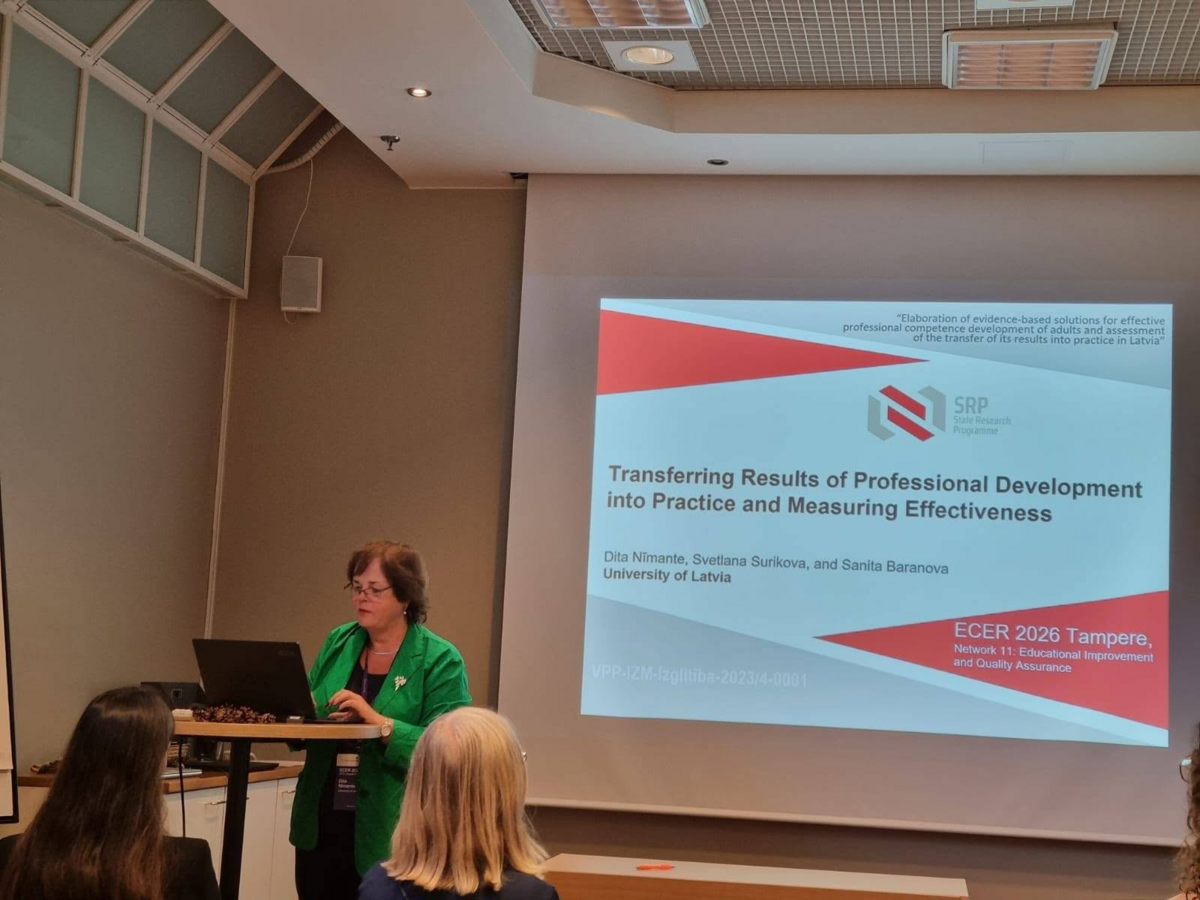
From 18 to 21 August 2026, the annual European Conference on Educational Research (ECER), organised by the European Educational Research Association (EERA), took place at Tampere University in Finland. This year’s central theme was “Knowing and Acting: The Changing Conditions and Potentials of Education Research”. Among the conference’s 3,619 participants were Dita Nīmante and Sanita Baranova, lead researchers of the State Research Programme (SRP) “Education” project “Elaboration of evidence-based solutions for effective professional competence development of adults and assessment of the transfer of its results into practice in Latvia” (project No. VPP-IZM-Izglītība-2023/4-0001).
During a session of Network 11, “Educational Improvement and Quality Assurance”, Professor Dita Nīmante, lead researcher at the Scientific Institute of Pedagogy, Faculty of Education Sciences and Psychology, University of Latvia (UL FESP SIP), presented findings from part of the project research in the paper “Transferring Results of Professional Development into Practice and Measuring Effectiveness”, co-authored by Svetlana Surikova and Sanita Baranova, lead researchers at UL FESP SIP.
The findings showed that the impact of professional development in Latvia is still not assessed sufficiently systematically. Based on focus-group interviews with 129 participants representing employees from various sectors, the study found that, in the Latvian context, the evaluation of professional development focuses primarily on programme quality and relevance, participant satisfaction, learning outcomes and individual performance. Less attention, however, is paid to how acquired knowledge and skills are transferred to the workplace, how they affect organisational performance, and what long-term outcomes they produce.
The findings indicate that the transfer of professional development is predominantly understood as the immediate application of new knowledge and skills at work. The most commonly used methods for assessing such transfer are workplace observation, analysis of individual performance, assessment of participant satisfaction and perceived benefits, as well as programme completion and certification results. At the same time, formal evaluation systems, baseline measurements, reflective evaluation methods and organisational-level performance indicators are used less frequently.
Consequently, the effectiveness of professional development transfer is most often determined on the basis of individual and readily observable changes, such as the application of new knowledge and skills, improvements in professional practice and employees’ personal growth. Impacts at the client, organisational and societal levels are assessed less frequently. Measuring the effectiveness of transfer remains conceptually unclear, methodologically fragmented, non-standardised and weakly institutionalised.
The study also identified differences in the perspectives of the various stakeholders involved. Professional development providers place greater emphasis on programme quality, evaluation and knowledge transfer; policymakers and sectoral councils focus on strategic oversight and regulation; while employers concentrate on employee performance and the application of new knowledge in the workplace.
In conclusion, the authors emphasised that the effective evaluation of professional development requires closer cooperation and shared responsibility among training providers, employers, policymakers and other stakeholders. A coherent, evidence-based evaluation system would make it possible to assess not only the quality of training but also its actual impact on professional practice, organisations and society as a whole.
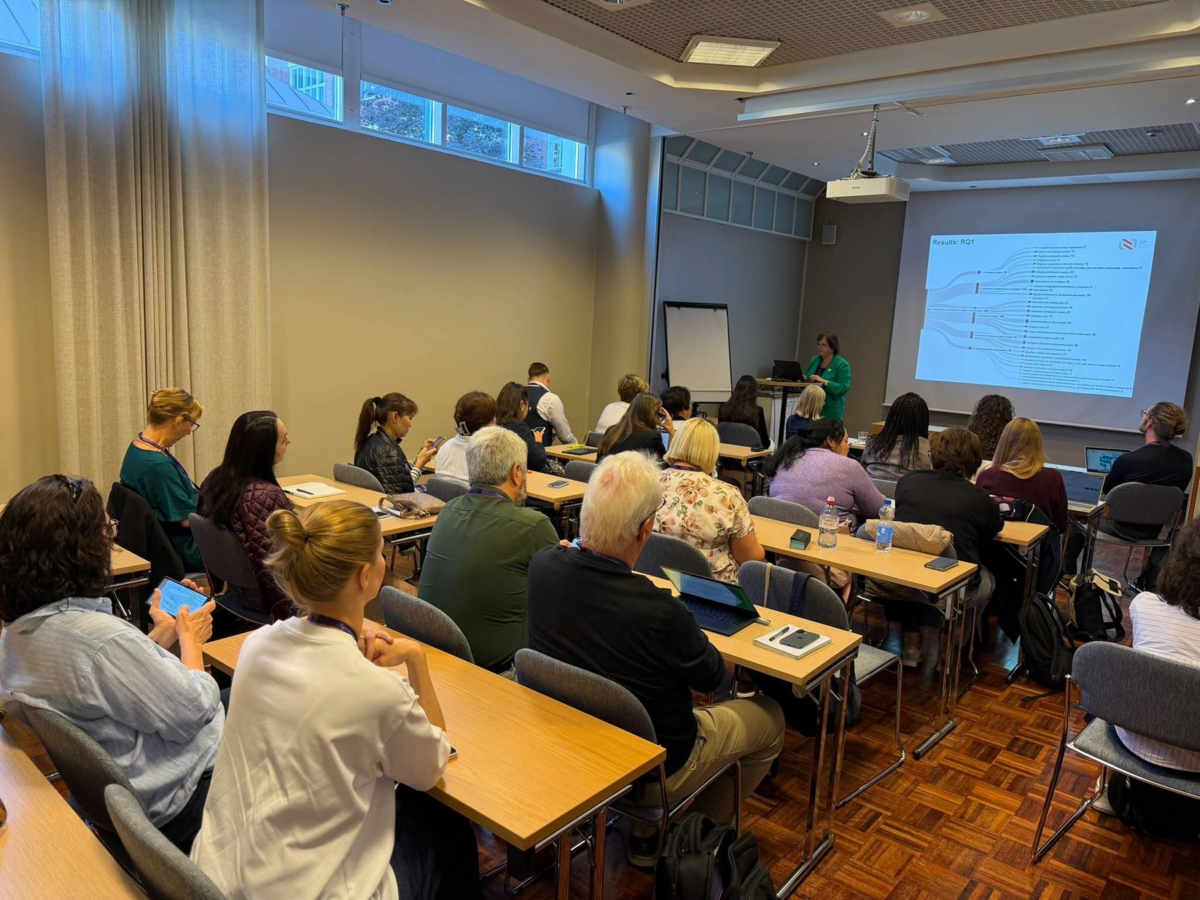
The conference session was well attended, and following the presentation participants raised questions specifically about barriers to transferring teachers’ professional development into practice. The questions were answered by associate professor Sanita Baranova.
The conference organisers invited participants to consider how the process of knowledge production in education is changing as not only national institutions but also international organisations, businesses and data-driven technologies become increasingly involved in research and decision-making. Considerable attention was also devoted to the challenges posed by digital technologies, including artificial intelligence and disinformation, as well as to the question of how the academic community can maintain its credibility and autonomy under these conditions.
The conference also focused on the role of education in the context of so-called “polycrises”, including the climate crisis, war in Europe, teacher shortages, population ageing and other interconnected global and local challenges. It highlighted efforts and potential solutions through which researchers can contribute to understanding and addressing these challenges, while strengthening the role of educational research in dialogue with decision-makers and representatives of different sectors.
